
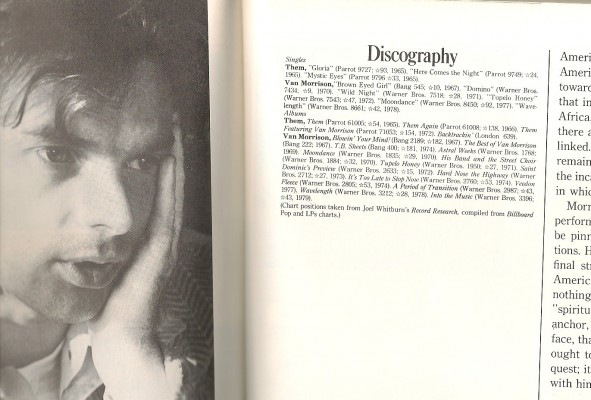


To those who were listening, it was clear that Van Morrison was as intense and imaginative a performer as any to emerge from the first wave of the post-Beatles British Invasion. Yet it was equally clear, to those who saw his early live shows in 1965, that Morrison lacked the flash and the flair for pop stardom possessed by such clearly inferior singers as Keith Relf of the Yardbirds or Eric Burdon of the Animals. Morrison communicated distance, not immediacy; bitterness, not celebration. His music had power, but also subtlety; as a white R&B singer he was a great lyric poet. Without the superb studio band that had played on his records, he seemed unfocused, and his music did not quite come across.What he lacked in glamour he made up in weirdness. He was small and gloomy, with more black energy than he knew what to do with, the wrong man to meet in a dark alley, or cross on a stage. He did not fit the maracas-shaking mold of the day; instead, in 1965, he recorded a shimmering version of “It’s All Over Now, Baby Blue” that in some ways was stronger than Dylan’s, and turned the fey Paul Simon composition “Richard Cory” into a bone-chilling horror story. Who was this Irish kid, singing folk songs and R&B with the raw emotion of a country bluesman, but never sounding black?
In 1966 Them broke apart for good, and Morrison took himself to New York under the wing of producer Bert Berns, scoring in 1967 with “Brown Eyed Girl,” his first Top Ten single, after which he was promptly forgotten. Brooding and drinking hard, Morrison moved to Boston, where, in an incomprehensible Belfast accent, he pestered late-night DJs for John Lee Hooker sides. Once he was booed off the stage when a group that would later make up part of the J. Geils Band called him out of the audience to front their version of “Gloria.” “Don’t you know who this is?” Peter Wolf shouted at the hissing crowd. “This man wrote the song!”
But they didn’t know. In 1967, when you said “Morrison” you meant the Doors, who, one read at the time in Crawdaddy, were preparing a treatment of “Gloria” that upon release (it never was released) would surely be greeted by the gathering storm of new rock fans as “a masterpiece.”
As if Van Morrison’s performance of “Gloria” had ever been anything else.
Bert Berns had tried. He and Morrison had followed “Brown Eyed Girl” with a dark, bluesy album called (with too-late trendy hopes) Blowin’ Your Mind; the music was well-made (Eric Gale played first-rate guitar), but also morbid. Sales were minimal. The signature track was titled “T.B. Sheets,” which was exactly what it was about. Who wanted to listen to an endless song about tuberculosis when the air was filled with the sounds of the Summer of Love?
Morrison returned to Ireland, apparently a burnt-out victim of the pop wars. There he wrote a set of songs about childhood, initiation, sex and death, which finally took form as Astral Weeks, a strange, disturbing, exalting album for which there was little precedent in rock and roll history when it was released in November 1968. Tempered by jazz restraint (Connie Kay of the Modern Jazz Quartet played drums, while the great Richard Davis provided the finest bass playing ever to appear on a rock and roll record) and three levels of string arrangements, the disc moved with a rock beat and a rock feel. It was as serious an album as could be imagined, but it soared like an old Drifters 45.
With Astral Weeks, Morrison opened the way to a new career, and established himself as a performer who deserved to be ranked with the creators of the very best rock and roll music. He has lived up to that promise.
Astral Weeks did not sell strongly, but it attracted widespread critical attention, and, in some sections of the country (most notably the San Francisco Bay Area), constant airplay on a few of the FM rock stations just then coming to the fore. Both reviews and airplay paid off with subsequent releases, and Morrison achieved a solid if not a mass popularity with Moondance (1970) and with singles such as “Domino” (1970) and the wonderful “Wild Night” (1971). He had moved to Woodstock, and he celebrated a pastoral life of domesticity and sexual delight; the hard edge of his early music, and the profound ambiguities of Astral Weeks, seemed well behind him. Then he relocated in Marin County, where his wife had grown up and where his popularity was fierce; one more album of good times (his best) followed, Tupelo Honey (1971); his domestic paradise fell apart; and his music turned tough once again, with Saint Dominic’s Preview (1972). Yet Morrison’s music has been of a piece.
“When I was very young,” the late Ralph J. Gleason wrote in a review of Moondance, “I saw a film version of the life of John McCormack, the Irish tenor, playing himself. In it he explained to his accompanist that the element necessary to mark the important voice off from the other good ones was very specific. ‘You have to have,’ he said, ‘the yarrrrragh in your voice.'”
Van Morrison has the yarrrrragh. His career, especially since Astral Weeks, can be seen as an attempt to deal with the yarrrrragh: to find music appropriate to it; to bury it; to dig it out; to draw from that sound, that aesthetic (for it is an aesthetic more than it is merely a sound), new tales to tell, or old tales to tell in new ways. The yarrrrragh is Van Morrison’s version of Leadbelly, of jazz, of blues, of poetry. It is a mythic incantation, and he will get it, or get close to it, suggest it, with horns (no white man working in popular music can arrange horns with the precision and grace of Van Morrison), strings, in melody, in repetition (railing the same word, or syllable, 10, 20, 30 times until it has taken his song where he wants it to go). To Morrison the yarrrrragh is the gift of the muse and the muse itself. He has even written a song about it: “Listen to the Lion.” Across 11 minutes, he sings, chants, moans, cries, pleads, shouts, hollers, whispers, until finally he breaks away from language and speaks in Irish tongues, breaking away from ordinary meaning until he has loosed the lion inside himself. He begins to roar: he has that sound, that yarrrrragh, as he has never had it before. He is not singing it, it is singing him.That is a mystical description; it is a mystical song. Much of what Morrison has done in the last years has been in this vein (though not obviously; Sri Chinmoy has yet to appear on one of Morrison’s LP covers). Certain themes have emerged in Morrison’s music, from album to album: an attempt to come to grips with his existence as an Irishman, whose homeland is in flames, who lives safely, if not peacefully, in America; a corresponding will to discover or recapture a mythical homeland, “Caledonia,” or Scotland, the place from which his ancestors originally came, ages ago; an attempt to shape and communicate a sense of freedom. All—the resolution of each of these questions—come down to the yarrrrragh, Morrison’s sound, which he cannot, it seems, get at will, which is definitely not “a style,” which is a gift and a mystery and understood as such. When Morrison touches that sound he is alive as an artist; he is an adventurer in mystic realms, a conqueror, a supplicant, whatever he would be. When he cannot get it—as on His Band and the Street Choir or Tupelo Honey. when he was likely not looking for it—he is an impeccable, satisfying, altogether masterful musician.
Morrison is heir to a tradition of mysteries, and he knows it. He is a Celt, and at least a spiritual descendant of the Irish prelate St. Brendan, who set out from Ireland 1500 years ago and who, according to legend, reached America itself, and perhaps founded a colony, which disappeared. So there may be a sense in which Morrison can understand that he was always an American (could have been, was meant to be); that his place in America is fated, even if it is unsettled, as he stretches out toward that mythical Caledonia, even believing, sometimes, that in a long and intricate manner, the blues came not from Africa, but from Scotland. That here came from there, that there are no divisions, that all parts of himself are, somehow, linked. Yet this is not a belief, it is a possibility, and the tension remains, driving the urge to wholeness, leading to albums like the incandescent Veedon Fleece (1974), or 1979’s Into the Music, in which every side of Morrison’s music touches every other.
Morrison remains a singer who can be compared to no performer in the history of rock and roll, a singer who cannot be pinned down, dismissed, nor fitted into anyone’s expectations. He is a conundrum: his mysticism, which is, I think, his final strength, is anchored by the day to day reality of the American life he has chosen, which is why his mysticism has nothing in common with the tawdry banalities prevalent in the “spiritual” rock and roll of the Seventies. But of course it is that anchor, that reality, that has brought his mysticism to the surface, that has demanded it. That is, one might think, the way it ought to work. Morrison, it can be seen now, is a man on a quest; it will be a long one, but there are listeners who will be with him for the duration.
The Rolling Stone Illustrated History of Rock & Roll, 1976, edited by Jim Miller (later updated for the 1979 version)
 GreilMarcus.net
I’ve always thought this is the best short overview of Van Morrison’s early career, and together with Lester Bang’s essay on Astral Weeks, and M Mark’s on It’s Too Late to Stop Now in “Stranded”, it’s part of an evocative trilogy. At the moment the BBC is running a 4-part interview with Van that is just extraordinary. Compared to his usual truculence with interviewers, he is forthcoming, generous and funny. The interviewer is Leo Green, a former musician in Morrison’s band (and the son of the UK jazz writer and pianist, Benny Green.) That could be the difference. Morrison even allows himself to credit music critics with keeping “Astral Weeks” enough in the limelight that it eventually turned from a minor cult favourite to a major cult favourite. That’s in the second episode – they are on line for about three weeks. Here’s the link to the first: http://www.bbc.co.uk/programmes/b04w75xl
Pingback: Van Morrison’s 50 Greatest Songs Countdown – #20 Listen To The Lion | Born To Listen
Pingback: Death and the Maiden: Van Morrison’s T.B. Blue(s)print – The Spooky Perambulator
I’ve long wondered about the Moondance review in which that “yarrrrragh” quote first appeared. Thanks to a footnote in Don Armstrong’s new biography of Gleason, the review can be found in the digital archives of the San Francisco Chronicle.
A Young Irishman Haunted by Dreams
By Ralph J. Gleason – San Francisco Chronicle, 1 March 1970
WHEN I was very young I saw a film version of the life of John McCormack, the Irish tenor, playing himself.
In it he explained to his accompanist that the element necessary to mark the important voice off from the other good ones was very specific. “You have to have,” he said, “the ‘yarrrrragh’ in your voice.”
A young redheaded Irish singer named Van Morrison has the “yarrrrragh” in his voice; his new album, “Moondance” (Warner Brothers 1835) shows this off to perfection.
Morrison has a totally individual sound, so individual that it is a rare occasion when, flicking on the box, you pick him up in the middle of a record and don’t recognize him. Very few singers, no matter how stylistically important they may have been, have had this special individuality and in the world of pop music, charades and symbolism included, it is even rarer than in jazz.
Morrison sings his own material, accompanies himself on guitar and produces his own records. On this one, he has used flute, drums, a fine pianist (Jeff Labes), rhythm, as well as tenor saxophone and occasionally a chorus.
The music is derivative of the main sources of American (which is now to say, international) pop music, ie: blues, gospel, folk. But there is a great deal more to what Morrison does.
Jazz Influenced
Unlike many of his contemporaries, Van Morrison is a singer who is jazz influenced (he had Connie Kaye and Richard Davis playing on his last LP). You can hear it in the edge he has to his voice. You can hear it also in the way in which he phrases, as well as in the relationship between the lyric line and the rhythm of the number, and how the other instruments are used. Van Morrison, at times, sounds like a jazz singer, much more than Donovan, for instance, who had similar influences.
His lyrics are poetic in the best sense, full of good images and impressive lines (as well as some banal ones) and they speak of love and alienation and sorrow and joy.
Intense Wailing
But it is really in the haunting quality of his sound that Van Morrison’s impact comes through most strongly. He wails. He wails as the jazz musicians speak of wailing, as the gypsies, as the Gaels and the old folks in every culture speak of it. He gets a quality of intensity in that wail which really hooks your mind, carries you along with his voice as it rises and falls in long, soaring lines.
Morrison lives now in rural New York not far from where the Band from Big Pink live and work. They, too. have had an influence on his music. You can hear it in ‘Caravan’ and in ‘Stoned Me’ as well as occasionally throughout the other eleven songs on the LP.
The temptation is to pick particular songs and say that they are the outstanding tracks. With the kind of artist Morrison is, this temptation ought to be strongly resisted. I suspect that the longer one plays this particular al-bum, as with The Band and The Beatles and Dylan, the more the emphasis and meaning
and weight will shift and what is the favorite of the moment will a month later be replaced by some other. That’s an important indication of the value of the music, I might add.
Right now I am deeply impressed with ‘Stoned Me,’ the opening track, ‘Moon- dance,’ which has a jazzy feeling to it plus excellent piano, tenor and solos, and ‘Crazy Love’ which is a marvelous love song full of the wildness of a summer love. The first line sets its mood: “I can hear her heart beat from a thousand miles.” He sings it softly and with an echo of someone I cannot quite place. Is it Charlie Brown?
About Charles
Throughout, Morrison constructs his songs with elements of spiritual, gospel, jazz and folk and even makes references within the lyrics. On ‘These Dreams of You’ following the line about Ray Charles having surmounted trouble, a beautiful tenor saxophone trill begins which sounds just like what might have been done by the Charles band. The album is full of little quotes like that (just as the ending of “Sundance Kid” is a reference to “Viva Zapata”) and it adds a little extra feeling.
No other singer at least no other solo singer has emerged recently with the vitality. maturity and completeness of Van Morrison. He is so convincing when he sings that it is very easy to become totally involved in the world which he is creating with his words. his music and his voice.
It is, I think, an indication of his special quality that I haven’t mentioned yet that basically the songs he sings are blues and blues- ballads. In terms of chords and melodic line this is true. In terms of the emotional mes- sage of the songs they are, like blues. universal. But in terms of Van Morrison’s sound. he does not sound like a blues singer nor as If he wants to sound like a blues singer. He sounds like a young Irishman haunted by dreams, a poet, one of the “children of rainbow, living in the morning of the world.”